Tell it about your game
Your level, the side you play, and the one thing you want more of. If you have already scanned a match, the app fills in what it already knows and you answer fewer questions.
RACKET FINDER
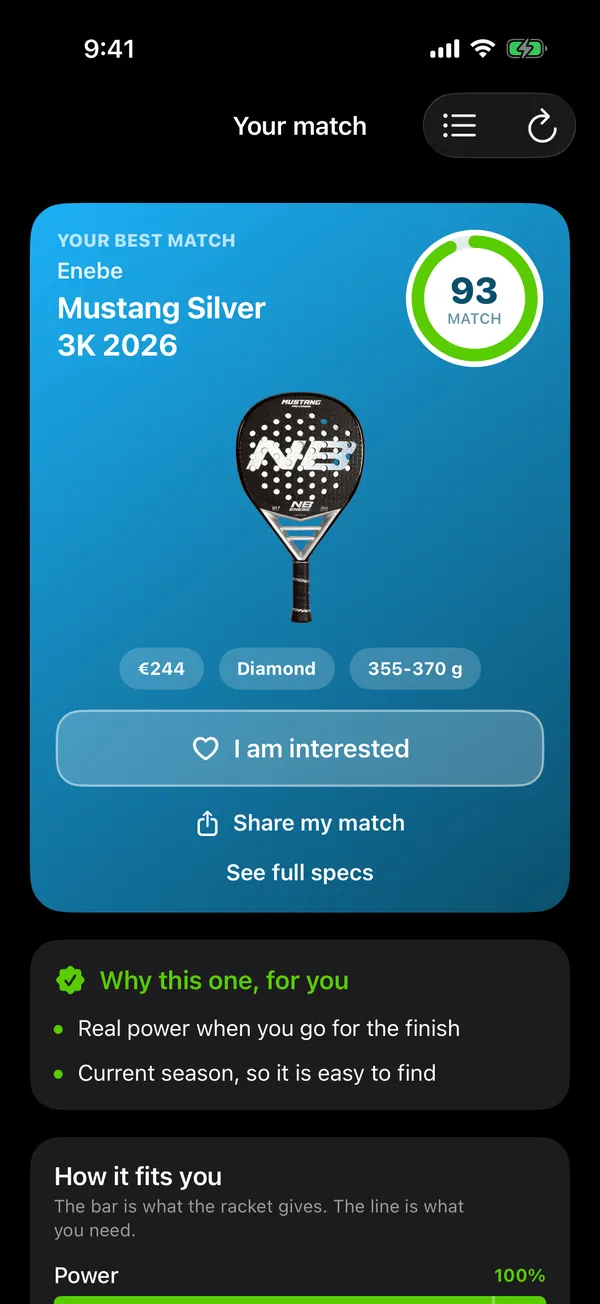
Answer seven questions and this free padel racket finder scores all 1,418 rackets in our catalogue on power, control, sweet spot, manoeuvrability, arm comfort and weight, then shows your five best matches. It is the same engine as the app, where it goes one step further and starts from your own match analysis.

TRY IT NOW
Seven questions, about a minute. Your answers stay in your browser.
7 questions · 1,418 rackets · free
Answer seven questions about your level, your side of the court, what you want more of and your budget. The finder scores every racket in the catalogue and shows your five best matches.
HOW IT WORKS
Three of the seven questions shape the result. The rest remove rackets that would be wrong for you.
Your level, the side you play, and the one thing you want more of. If you have already scanned a match, the app fills in what it already knows and you answer fewer questions.
Arm or elbow trouble rules stiff frames out completely rather than just moving them down the list. Your budget caps the shortlist. Naming your current racket lets the app tell you whether changing is even worth it.
Every racket is scored on power, control, forgiveness and arm comfort, with a plain sentence explaining why it came up for you. Save the ones you like and compare them side by side.
THE SHAPE QUESTION
Padel racket shape sets the balance point, and the balance point decides whether the racket forgives you or punishes you.
| Shape | Balance | Best for | The trade-off |
|---|---|---|---|
| Round | Low, near the handle | Beginners, control players, anyone with arm trouble, and most right-side players who build the point and need to place the ball. | The sweet spot is large and central, so mishits still go in. You will not get free power on the smash. |
| Teardrop | Medium | Improving and intermediate players who do not want to choose yet, and most players below 4.5. | A genuine middle ground. It does nothing badly, which also means it does nothing spectacularly. |
| Diamond | High, near the head | Advanced attacking players, usually on the left side, who finish points with the smash and víbora. | Maximum power from a small, high sweet spot. Mishit it and the ball dies, and it is the hardest shape on the elbow. |
BUYING GUIDE
Most players buy the racket their favourite pro uses, discover it is a stiff diamond built for a 6.0 smash, and spend a season fighting it. Here is what actually decides whether a racket suits you.
The right side and the left side need different rackets. The left side finishes points, so it usually wants power and a higher balance. The right side builds points and covers the middle, so it usually wants control and a bigger sweet spot. Two players of identical level on opposite sides should not be shopping for the same racket.
Most padel rackets sit between 350g and 375g. Lighter is faster at the net and kinder on the arm. Heavier gives you more free power and absorbs pace better on defence. If you play twice a week and your arm is fine, do not automatically pick the lightest frame in the shop.
Soft foam cores feel comfortable, hold the ball longer and forgive slow swings. Hard EVA cores give more power and a crisper response, but they are unforgiving if your timing is off and they transmit more shock to the elbow. If you have ever had tennis elbow, this is the single most important spec on the sheet.
Rough carbon surfaces grip the ball and generate the spin that makes a víbora work. Smooth fibreglass is softer and quieter. Carbon frames are stiffer and more powerful, fibreglass frames are more flexible and more comfortable. Neither is better in the abstract, only better for a specific arm and a specific swing.
A diamond-shaped carbon racket will not give you a pro smash. It will punish every ball you catch slightly off centre, which at most levels is a lot of balls. Buy for the game you have now, and change when your scan scores say the game changed.
Your bandeja lands 68% of the time but your net control drops off. You need a teardrop with a soft core, not the diamond you are swinging now.
That sentence is what a racket finder should produce, and it is only possible because the app has already watched you play. Scan a match first and the recommendation gets sharper.
WHY THIS ONE IS DIFFERENT
If you have analysed a match, the finder already knows your technique scores. A quiz on a retailer site can only ask you what you think your level is.
Tell it your elbow plays up and stiff frames disappear from the list entirely. No amount of good marketing puts them back.
Name the racket you play with now and the app will say plainly if the upgrade is not worth the money yet.
The catalogue covers over 1,400 models across every brand, so there is no house brand to push to the top.
FAQ
Yes. The finder at the top of this page is free with no sign-up, and the same finder and the full racket catalogue are free in the Padel AI app on iPhone and Android. The AI gear chat, where you can ask follow-up questions about a specific racket, is part of the subscription.
1,418 models across 29 brands, from 2020 to the current season. Each one is scored on power, control, sweet spot, manoeuvrability, arm comfort and weight against your answers, so the shortlist is ranked on the things that change how the racket feels rather than on brand or price alone.
For almost every beginner it is a round or teardrop racket with a soft core, a low or medium balance, and a weight around 355g to 365g. That combination gives the largest sweet spot, which means more balls stay in play while your timing is still developing. The specific model matters far less than getting those three things right.
Round if you are starting, playing the right side, or have any arm trouble. Teardrop if you are improving and do not want to commit yet, which covers most players below 4.5. Diamond only if you are an advanced attacking player who finishes points with the smash and can consistently hit the middle of the strings.
No, the finder works on its own from the seven questions. But if you have run a video analysis, the app uses your real technique scores instead of your self-assessment, and the recommendation gets noticeably more specific.
Most recreational players get one to two years out of a racket before the core softens noticeably and it starts to feel dead. Change earlier only if your game has genuinely moved, for example your smash has become a real weapon and your current frame no longer gives you anything back.
MORE IN THE APP
PADEL AI PARTNER PROGRAMME
Share your link and earn 20% of every player who joins through it, for a full year of their renewals. Free to join, no follower minimum.
Seven questions, and a shortlist that matches the way you actually hit the ball.

