Six technique scores
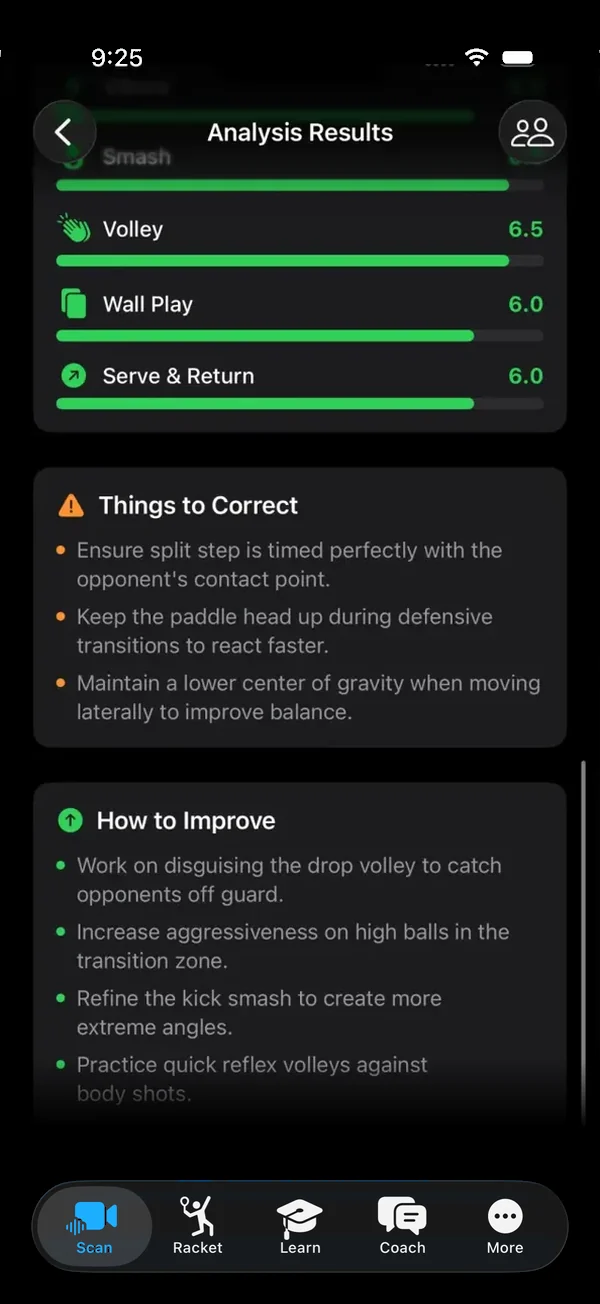
Every analysis scores Bandeja, Víbora, Smash, Volley, Wall Play and Serve and Return separately, each on the same 1.0 to 7.0 scale. Your overall level comes from the combination.
LEVEL & PROGRESS
Almost everyone guesses their padel level wrong, usually by half a point in the direction that flatters them. Padel AI scores your level from what you actually did on court, on the same 1.0 to 7.0 scale your club uses to match you.


THE LEVEL CHART
The 1.0 to 7.0 scale is the level system used by Playtomic and by padel clubs worldwide. This is what each band actually looks like on court.
| Level | Band | What it looks like |
|---|---|---|
| 1.0 - 1.5 | New | You are learning the serve and the basic rally. Contact is inconsistent and the walls are still an obstacle rather than a tool. |
| 2.0 - 2.5 | Beginner | You can sustain a rally. You know the scoring, you serve underhand reliably, and you are starting to let balls come off the back glass. |
| 3.0 - 3.5 | Lower intermediate | You hold the net when you get there and you have a lob. Your overhead is mostly a flat smash. Positioning as a pair is inconsistent. |
| 4.0 - 4.5 | Intermediate | You have a working bandeja and you use it to keep the net. You play the walls deliberately. You start to pick targets rather than just returning the ball. |
| 5.0 - 5.5 | Upper intermediate | Your bandeja and víbora are real shots with spin and placement. You move as a pair, you defend the smash off the glass, and you build points. |
| 6.0 - 6.5 | Advanced | Consistent power and control under pressure. You attack the correct ball, finish with por tres or por cuatro, and rarely give away free points. |
| 7.0 | Professional | Full command of every shot at speed. This is the level of players competing on the professional tour. |
HOW WE MEASURE IT
Most level tests ask you how good you think you are. That is the one question a level test should never depend on.
Every analysis scores Bandeja, Víbora, Smash, Volley, Wall Play and Serve and Return separately, each on the same 1.0 to 7.0 scale. Your overall level comes from the combination.
The six scores are drawn as one shape. A player with a 5.5 smash and a 3.0 wall game is not a 4.5 player, they are a player with an obvious hole. The hexagon makes that impossible to miss.
Add matches manually or import your Playtomic level to keep one continuous history. Each new analysis updates your Padel AI Points, so progress is a line rather than a feeling.
BACKGROUND
Padel borrowed its level scale from tennis, where a similar 1.0 to 7.0 system has been used for decades to arrange fair matches. Playtomic made it the default in padel by attaching it to court bookings: your level decides which open matches you can join, so a wrong number wastes everybody's evening.
A booking-app rating moves on match results. That sounds objective, but results depend heavily on who your partner was, who you happened to be drawn against, and whether the other pair had an off night. Win three matches carried by a strong partner and your number goes up without your game changing at all.
A technique score works the other way round. It ignores who won and looks only at how you hit the ball, which is why the two numbers are useful together rather than in competition.
Players routinely describe themselves as "about a 4" when they are a 3.5. It sounds like a rounding error. On court it is the difference between having a bandeja and not having one, and it is the most common reason an open match feels one-sided.
Not by improving your best shot. Almost every player below 5.0 has one technique two full points behind the rest, and that is the one opponents will find within three games. Fixing the worst score moves your level faster than polishing the best one, which is exactly why the analysis reports the six scores separately instead of giving you one average.
FAQ
It is the level system used by Playtomic and by padel clubs worldwide. 1.0 to 2.0 is beginner, 2.5 to 3.5 is lower intermediate, 4.0 to 5.0 is intermediate to upper intermediate, 5.5 to 6.0 is advanced, and 6.5 to 7.0 is professional. Padel AI scores every technique on this same scale, so your results map directly to the level you use to book matches.
The short version: if you can rally but the walls still surprise you, you are around 2.5. If you hold the net and have a lob but your overhead is a flat smash, you are around 3.5. If you have a working bandeja and use it to keep the net, you are around 4.5. The reliable way to know is to film one match and let the analysis score your six techniques rather than estimating.
Most regular club players sit between 3.0 and 4.5, and that band covers the large majority of people who play twice a week. Anything at 5.0 or above is a strong club player. There is no level at which the game stops being enjoyable, and the most common mistake is claiming a level half a point above your real one, which produces uneven matches.
A Playtomic rating moves on match results, so it is influenced by your partner and your opponents. A Padel AI level is measured from your technique in the video, independently of who won. You can import your Playtomic level into the app to keep both numbers in one history.
For a player training once or twice a week, half a level in three to six months is realistic in the 3.0 to 4.5 range, and it slows down noticeably above 5.0. The fastest gains come from fixing your single weakest technique rather than from playing more matches.
Yes. Every analysis updates your Padel AI Points, and the app keeps a chart of each technique separately. You can also add matches manually and import your existing Playtomic level so the history starts from where you already are.
MORE IN THE APP
PADEL AI PARTNER PROGRAMME
Share your link and earn 20% of every player who joins through it, for a full year of their renewals. Free to join, no follower minimum.
One match video, six technique scores, and an honest number.