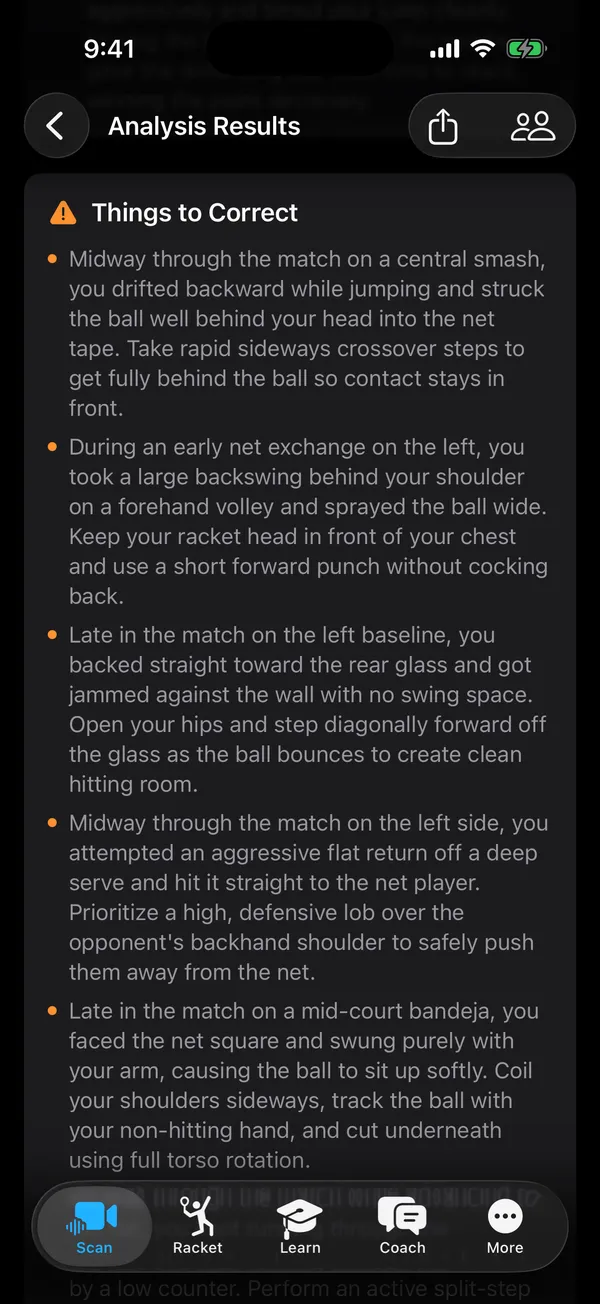
The analysis finds the gap
Your six technique scores are rarely even. The one that sits furthest below the others is the one opponents will target, and it is the one the app flags.
TRAINING
Most players practise whatever they already enjoy hitting. The training library works the other way round: it reads your technique scores, finds the shot that is two points behind the rest, and hands you the coaching videos and drills for that.


HOW IT WORKS
The library is useful on its own. It becomes a training programme once the app has seen you play.
Your six technique scores are rarely even. The one that sits furthest below the others is the one opponents will target, and it is the one the app flags.
All 612 videos are tagged by technique and by one of four skill levels, so a 3.5 player working on the bandeja never gets handed a session written for a 6.0.
Each drill explains the setup, what to focus on, and what good looks like. Run it in your warm-up or in a dedicated session, then scan another match to see if the number moved.
THE CATEGORIES
Every video is tagged by technique and by skill level, so you can go straight to what you need. The counts below are what is in the library today.
| Category | Videos | What it covers |
|---|---|---|
| Volley | 169 | Net play before the bounce: block volleys, drop volleys, and the backhand volley that most players hide. |
| Smash | 82 | Finishing the point, including the kick smash, the flat smash and hitting por tres. |
| Bandeja | 76 | The defensive overhead with backspin that lets you keep the net. |
| Víbora | 71 | The aggressive overhead played with side spin and sharp angles. |
| Forehand | 63 | Groundstrokes from your dominant side, including off the glass. |
| Backhand | 43 | The non-dominant side, usually the first place opponents look for a weakness. |
| Serve | 41 | The underhand serve, placement, and the position you take after it. |
| Return | 26 | Answering the serve in a way that lets you take the net, including returns off the side glass. |
WHO MADE THEM
The library is curated from established padel coaching channels rather than scraped at random. You can always see who is teaching you.
| Channel | Known for |
|---|---|
| The Padel School | One of the largest padel coaching channels in English. Strong on serve, return and match strategy. |
| Otro Nivel Padel | Detailed technical breakdowns, particularly on the víbora and net positioning. |
| Padel Drive | Technique correction and common-error videos across every shot. |
| Dani Hoyo Padel Coach | Fundamentals explained for beginners, including grip and body position. |
| EverythingPadel | Advanced shots and wall play, including returns off the side glass. |
| Hello Padel Academy | Positioning and backcourt control for developing players. |
| Raphael Cuesta Padel | Smash variations, pronation and footwork. |
| the4Set | Sessions featuring professional players, including Juan Lebrón. |
HOW TO PRACTISE
Two players book a court for an hour of "training", hit for fifty minutes, and go home having practised the shots they were already good at. This is the normal outcome, and it is why so many players plateau at 3.5 for years.
Nobody enjoys drilling the shot they are worst at. That is exactly why it stays worst. If your backhand wall defence is a full point behind everything else, that is where the next half level is hiding, and no amount of smash practice will find it.
A drill with a clear success condition beats vague rallying every time. "Ten bandejas that land past the service line and let me hold the net" is a drill. "Working on my bandeja" is a warm-up.
The reason technique work usually stops is that nobody can tell whether it worked. Scanning a match before and after a month of drilling turns that into a number, and a number that moved is the only thing that keeps people training.
The ten minutes before every match are the easiest training slot in your week because they already exist. Running one specific drill there, instead of hitting comfortable forehands, is the highest-return change most club players can make.
Once you know which technique to attack, the lessons explain the shot and the AI coach answers the follow-up questions.
FAQ
It compares your six technique scores from your video analysis and identifies which one is furthest behind the others. It then filters the drill library to that technique and to your skill level, so you get drills aimed at the gap rather than at the shot you already like hitting.
Yes. You can browse all 612 videos across eight technique categories and four skill levels directly. The analysis only changes which ones are recommended to you first.
612 coaching videos in total. Volley is the largest category with 169, followed by Smash with 82, Bandeja with 76 and Víbora with 71. Serve has 41 and Return has 26, which reflects how much less coverage those two shots get from padel coaches generally.
They are curated from established padel coaching channels rather than produced anonymously, including The Padel School, Otro Nivel Padel, Padel Drive, Dani Hoyo Padel Coach, EverythingPadel, Hello Padel Academy, Raphael Cuesta Padel and the4Set. Every video shows which coach it came from.
Most are written for two or four players on a normal court, which is how padel is played. Some can be run against a wall on your own. Each one states what it needs before you get to the court.
For most beginners the highest-return work is wall defence, so the glass stops being a threat, and the lob, because a reliable lob is the single fastest way to take the net away from better opponents. Both are tagged at Beginner level in the library.
One focused session or warm-up per week on a single technique, for about a month, then scan again. Changing target every session is the most common reason nothing improves.
MORE IN THE APP
PADEL AI PARTNER PROGRAMME
Share your link and earn 20% of every player who joins through it, for a full year of their renewals. Free to join, no follower minimum.
Scan a match, get the drills that match the gap.